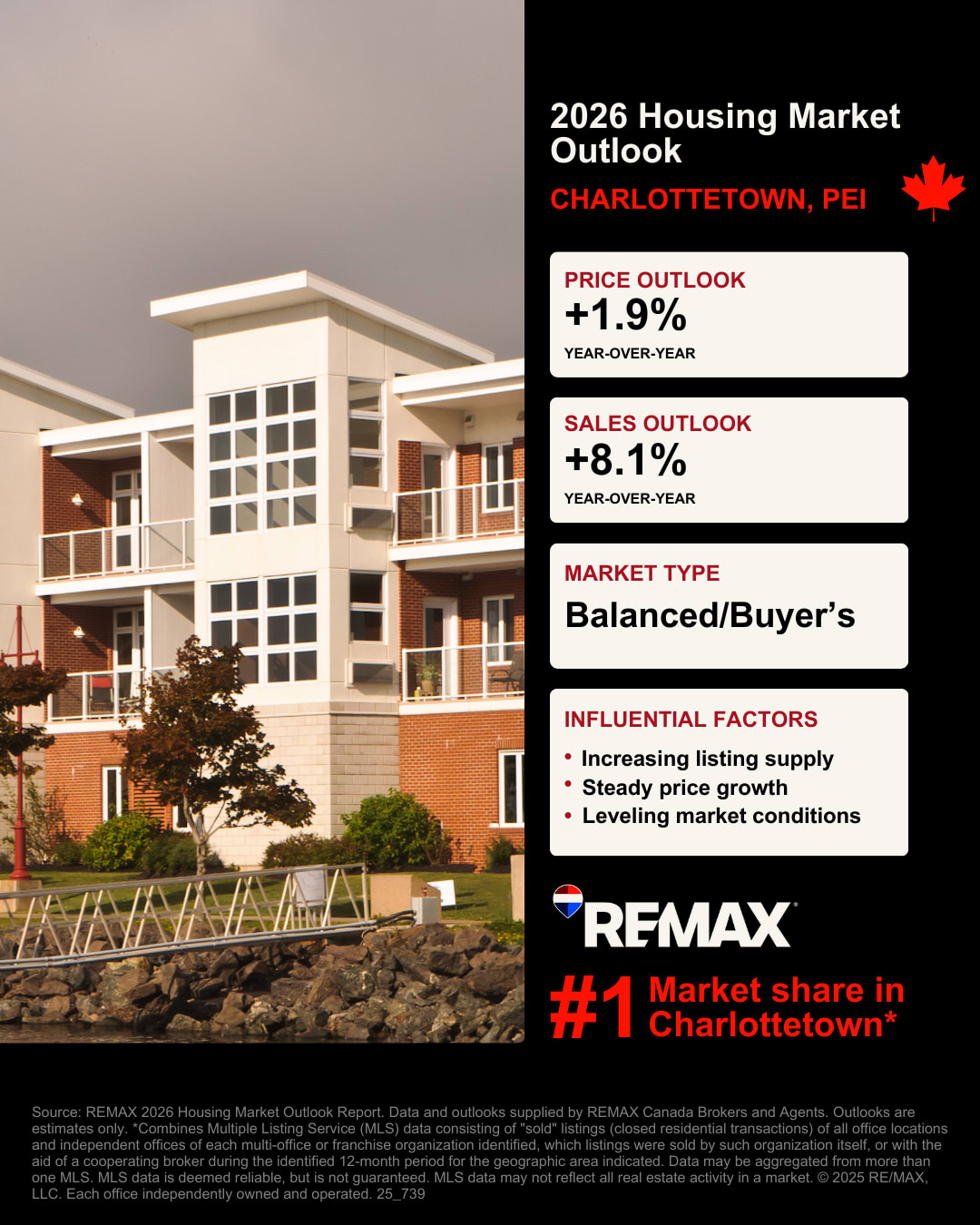
The average residential sale price in Charlottetown has increased by 1.9 per cent across all property types between 2024 and 2025 from $412,000 to $420,000. The number of sales transactions increased by 8.1 per cent for the same time period (from 602 to 651). The total number of listings increased by 10 per cent (from 1,204 in 2024 to 1,324 in 2025).
Trends in the Charlottetown Housing Market
Average residential sale prices will rise by two per cent going into 2026, compared to 2025. Sales are anticipated to rise by five per cent going into 2026, compared to 2025. Charlottetown is anticipated to be a balanced-to-buyers market in 2026, with good opportunities for buyers to enter the market while maintaining steady demand that supports modest, sustainable price growth.
Looking ahead to 2026 in Charlottetown, there are certain neighbourhoods to keep an eye on. Brighton, Charlottetown will remain popular for its established appeal and consistent demand regardless of market conditions. The Primrose/Waters Edge neighbourhoods in Cornwall will continue to attract buyers, as the next phases of these communities offer modern homes and benefit from planned infrastructure and commercial development supporting long-term growth. East Royalty is also set to remain a sought-after neighbourhood, with ongoing development keeping it a key area of interest for buyers.
Single-detached homes are expected to see the strongest demand in 2026 due to their appeal to move-up and move-over buyers seeking more space, retirees prioritizing greater privacy and low-maintenance living, and families or investors looking for long-term stability and a more flexible lifestyle.
Looking ahead to 2026, first-time homebuyers in Charlottetown are leaning towards newly constructed homes priced between $350,000 and $550,000. Move-up and move-over buyers are seeking larger single-detached homes in the $550,000 to $750,000 range, offering space for growing families, safe neighbourhoods, and room to play. Retirees are focused on slab-on-grade homes priced $450,000 to $550,000, prioritizing functional layouts and garages. In new construction, entry-level homes in the $400,000 to $550,000 range are leading the market, as demand for large spec homes has declined. Developments are proceeding as planned, supported by provincial incentives offering 2 per cent interest on construction financing, which has maintained infrastructure growth and eased pressure on the housing market, bringing it closer to a balanced, buyer-favourable environment.
The Charlottetown market has seen a firm increase in units sold, a trend expected to continue. The primary adjustment moving forward is managing seller expectations, as the massive year-over-year value increases in the past are no longer typical, with more moderate gains anticipated. The first-time buyer downpayment assistance program is helping more buyers transition from renting to homeownership, though it still remains relatively underutilized.
Investors in Charlottetown are approaching the market cautiously. Strict rent controls have left some older buildings struggling to maintain value or cover costs, leading to disrepair in certain cases. New construction remains viable, as rents can be set to cover expenses and adjusted after major renovations, but mid-range properties are facing the greatest challenges under current regulations.
From a strategic standpoint, 2026 is an opportune time to buy in Charlottetown. Prices have remained stable without drastic increases, and interest rates are unlikely to decline significantly, making now the ideal moment to secure a property. Falling interest rates have provided a boost to the Charlottetown market, even as some builders adjust profit margins to keep projects viable. Lower rates are encouraging hesitant buyers to enter the market, and as interest stabilizes, the overall housing market is expected to stabilize as well. The foreign buyer ban has significantly slowed the market in Charlottetown, with wide-reaching impacts on the local economy.