
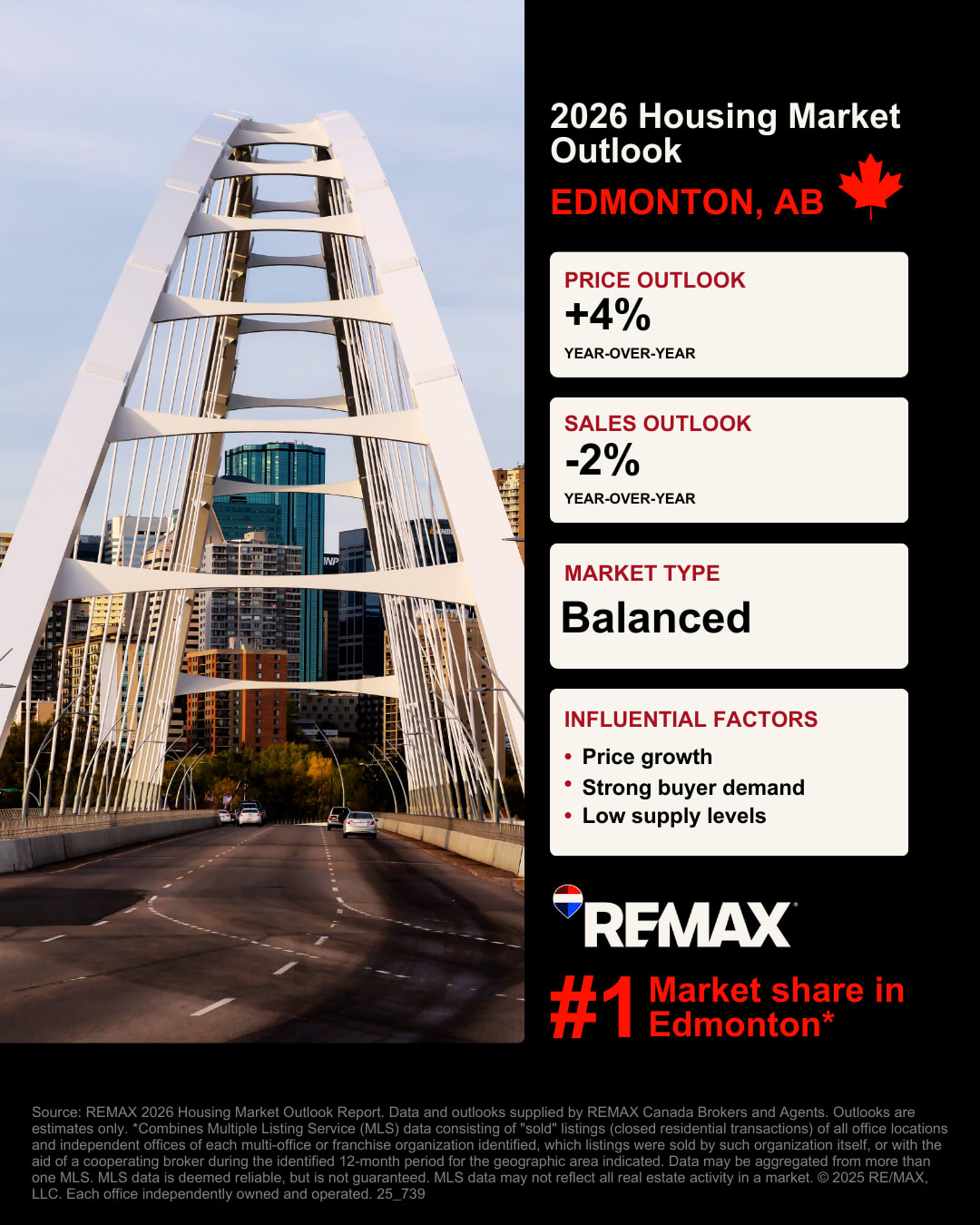
The average residential sale price in Edmonton has increased by 6.3 per cent across all property types between 2024 and 2025 from $431,994 to $459,179. The number of sales transactions decreased by 5.6 per cent for the same time period (from 25,297 to 23,878). The total number of listings increased by 8.4 per cent (from 33,135 in 2024 to 35,931 in 2025). Average residential sale prices will rise by four per cent going into 2026, compared to 2025. Sales are anticipated fall by two per cent going into 2026, compared to 2025.
Trends in the Edmonton Housing Market
Looking ahead to 2026, Edmonton will be a balanced market, while a few areas for single family and luxury are sellers' market conditions. The neighbourhoods expected to be the most desirable in the region heading into 2026 are Wihkwentowin (formerly Oliver) in the downtown central area, Castle Downs on the Northside, and Chappelle in the southwest. These areas are attracting buyers due to a combination of factors, including convenient access to amenities, schools, and transit, as well as a variety of housing options that suit different buyer needs. Demand in these neighbourhoods is driven by their established communities, quality of life, and long-term investment potential.
Single detached homes are expected to see the highest demand and sales activity in the region in 2026. Move-up and move-over buyers are seeking larger homes with additional space, while retirees looking to downsize continue to value the privacy and outdoor areas these properties offer. Single detached homes also remain attractive to buyers focused on long-term stability and investment security. Looking ahead to 2026, several trends are shaping the buying and selling landscape in the region. First-time homebuyers are purchasing condos priced between $250,000 and $300,000, with young professional couples extending up to $400,000. Move-up and move-over buyers are trading homes in the $400,000 to $550,000 range to access newly built properties valued between $600,000 and $800,000. Retirees are selling their larger homes to downsize, moving into rental communities tailored to age and health needs, with sale prices ranging from $400,000 to $800,000. Demand remains strong for older-age housing in mature communities. New home construction is robust, primarily consisting of single-family detached homes, many with rental or garage suites. Infill developments include rowhouse-style townhouses with rental suites, often financed through CMHC (Canada Mortgage and Housing Corporation) Mortgage Loan Insurance Select programs for rental or resale as individual units. Additionally, apartment-style high-rises and walk-ups are being built for rental purposes, with some condos developed for resale. Across all areas, new developments are proceeding as planned but demand often outpaces the pace of construction.
In Fall 2025, several factors are influencing the housing market and pointing toward potential continued strength in 2026. The Bank of Canada's lowering of interest rates is improving affordability for buyers, and overall developing resiliency for ongoing economic instability. Continued in-migration is sustaining strong housing demand. With municipal elections concluded in October, some buyers who had previously delayed decisions are returning to the market. Additionally, increased listing inventory is providing more opportunities, allowing buyers who were previously unsuccessful in competitive bidding situations to re-engage with greater choice.
In Edmonton, affordability remains the most significant factor influencing first-time buyers. The city offers relatively high average incomes and strong employment opportunities, combined with lower taxes, allowing buyers to maintain a balanced lifestyle rather than being "house poor." Although average rents have softened slightly into the fall of 2025, this is consistent with seasonal trends. Many buyers can purchase homes for less than the cost of renting, even with minimum down payments of five percent. Factors such as cash flow potential for investors, building equity, and the absence of land transfer taxes on portable mortgages further motivate tenants to transition into homeownership.
Current rental prices are supporting strong investor activity in Edmonton, with cash flow achievable across multiple segments of the market. Investor demand initially focused on entry-level condominiums priced under $100,000, most of which have now been purchased and appreciated in value. At the same time, investors are acquiring 6-10-unit rowhouse-style infill properties, often using the CMHC MLI Select financing program. The combination of affordable rental rates, accessible financing, and zoning bylaws that permit this type of infill construction has created a favorable environment for investor activity in the city.
For buyers who have not yet entered the market, 2026 is expected to be a strategic year to purchase, as waiting may result in being priced out of the market, similar to trends seen in Calgary. Inventory remains limited, and demand continues to support steady price growth, underscoring the importance of timely action for prospective buyers.
Heading into 2026, Edmonton's housing market remains highly active, with little sign of slowing. Recent reductions in interest rates, including attractive fixed-rate offers from lenders such as Scotiabank, are encouraging renewed buyer activity. These developments are contributing to strong demand and a highly competitive market, particularly in segments where affordability aligns with available financing options.
Affordability is the major theme still, although as prices continue to climb and cost of replacement housing or new product cost continue to increase with tariffs and other challenges, it is anticipated to continue through 2026. Luxury is also notable, with strong demand for luxury in the $1,000,000 to $1,500,000 single-family price point. With the same concept, builders can't build it fast enough to keep up with demand, plus most buyers believe if they wait those homes will only cost more in the next few years based on inflationary pressures on costs and labour.
Based on tighter seller market conditions, less listings to choose from, and the coming soon regulatory rule changes… in certain segments of the market, consumers literally follow agents on social media to watch for news before it hits the market. Then, they'll 'jump' on listings and make direct offers, mostly as unrepresented customer status from a representation perspective. Edmonton is also seeing a growing problem of some agents advertising or featuring homes on their social platforms without the permission of the listing agent/brokerage and seller. This has become increasingly important for agents to monitor online activity about their listings, to ensure it's being marketed accurately and in compliance with ethics and rules from governing bodies such as CREA.
Many Ontario agents without proper Alberta licenses are advertising or promoting properties in Edmonton. Some are following the rules and getting their licenses in Alberta as well, but is a challenging time for buyers, sellers and industry members alike. As it's creating distrust with consumers and industry members alike when Ontario agents are promoting properties in Alberta.