
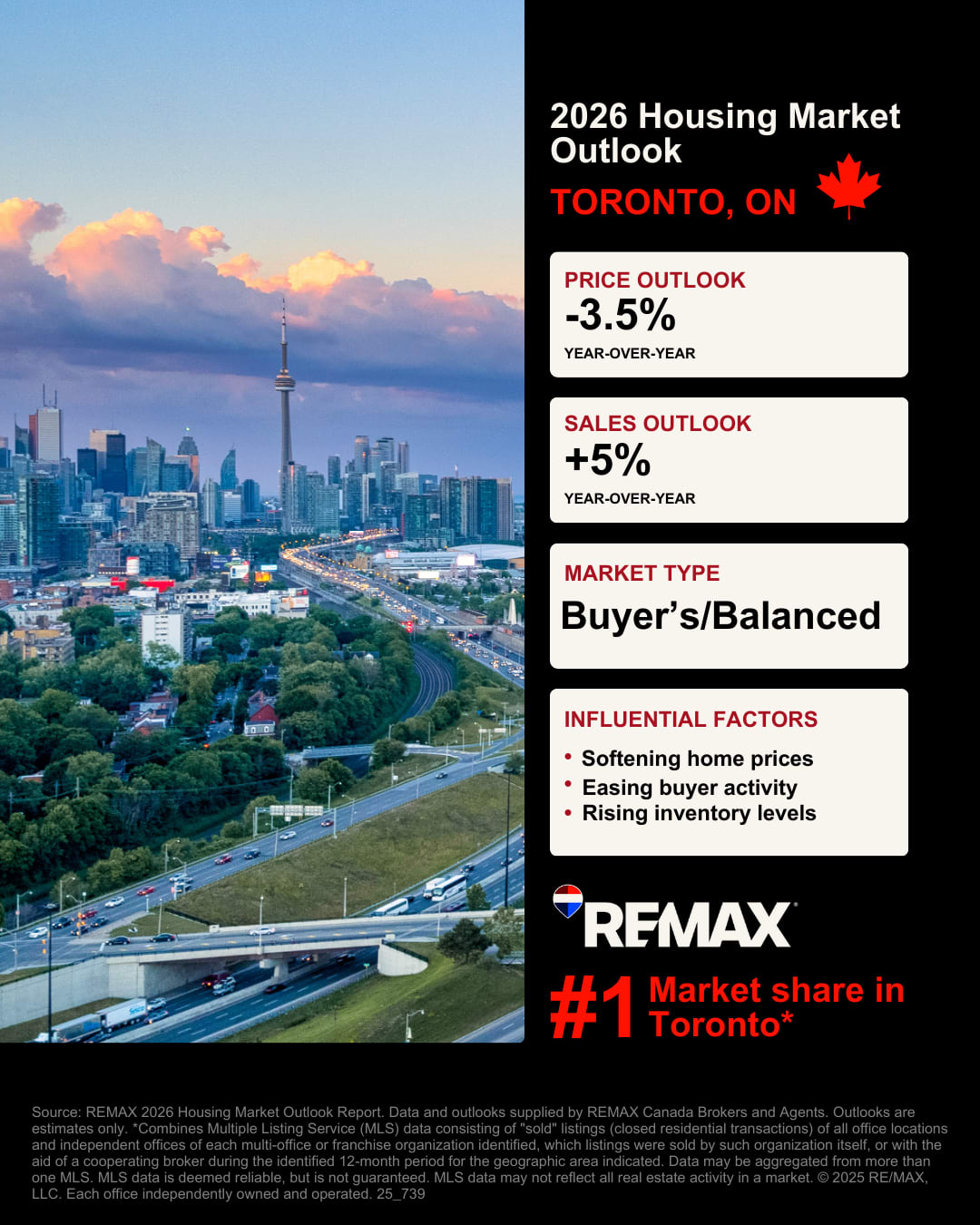
The average residential sale price in the Greater Toronto housing market has decreased by 4.2 per cent year-over-year across all property types in 2025, from $1,121,871 to $1,074,978.The number of sales transactions decreased by 10.7 per cent for the same time period (from 60,272 to 53,813). The total number of listings increased by 17.2 per cent (from 23,722 in 2024 to 27,808 in 2025). Average residential sale prices are expected to fall by 3.5 per cent in 2026, compared to 2025. Sales are anticipated to rise by five per cent going into 2026, compared to 2025.
Trends in the Toronto Housing Market
Looking ahead to 2026, the Greater Toronto Area is expected to shift toward a balanced-to-buyer market, with conditions offering more opportunities for buyers while still maintaining steady demand. Price adjustments and lower interest rates are likely to support affordability, encouraging renewed activity across both entry-level and move-up segments.
The top three neighbourhoods expected to be most desirable in 2026 are Waterfront Communities (West of Yonge), the Bay Street Corridor, and the University area. The return to in-person work for government and finance employees, combined with price adjustments and lower interest rates, is making the condo and apartment market more accessible, driving renewed demand in these urban, transit-connected areas.
In 2026, single-detached homes are expected to be the most sought-after housing type in the region, driven by continued demand from families and move-up buyers seeking space, privacy, and long-term value. Limited inventory and slower new-home construction will keep detached properties competitive, particularly in established suburban areas offering access to schools, amenities, and transportation.
Looking ahead to 2026, buying and selling activity will remain measured as affordability and financing pressures persist. First-time buyers are focused on homes up to $750,000, often relying on parental support for down payments. Move-up and move-over buyers are actively between $750,000 and $2 million, encouraged by a narrower price gap between smaller and larger detached homes. Retirees continue to buy up to $1.5 million, often downsizing, using reverse mortgages, or helping their children enter the market. On the supply side, new-home construction is expected to stay slow, with many GTA projects postponed or cancelled due to high costs. This is likely to negatively affect any new supply.
The Greater Toronto Area is showing signs that it could begin to rebound in 2026. Ongoing price adjustments are helping stabilize the market, while continued interest-rate decreases are expected to improve affordability and encourage more buyers to re-enter the market. Together, these conditions will entice homebuyers and sellers in the year ahead. Strong rental prices are influencing first-time buyers to consider homeownership sooner. Some renters who can afford current rents are realizing that purchasing a home could be the way to go, offering a more cost-effective alternative in the long run.
Current rental prices are beginning to make real estate investments more attractive. While many investors have remained on the sidelines, adjusted home prices and lower interest rates are creating conditions that could encourage renewed buying activity.From a market perspective, 2026 is expected to be a strategic year to buy. While it’s impossible to perfectly time the market bottom, ongoing price adjustments and lower interest rates are improving affordability, making it an opportune time for buyers to enter despite potential price volatility and inventory constraints resulting from cancelled projects.
Heading into 2026, declining interest rates are expected to support increased home sales in the region, as borrowing becomes more affordable for buyers. Even if rates rise later in the year, the early momentum generated by lower rates should help sustain market activity for at least the first half of 2026 for buyers and sellers.Heading into 2026, continued price adjustments and lower interest rates are expected to support market activity, although economic uncertainty may temper rapid growth. Notable trends are also emerging in rental segments, where strong demand and limited supply continue to shape pricing and buyer behaviour.
Policy is expected to play a significant role in the local housing market in 2026. Federal initiatives aimed at stimulating buyers—such as extending amortization periods or reducing the stress test rate—could help improve affordability.Technology continues to reshape how buyers search for homes, with a noticeable shift from traditional Google searches to AI tools such as ChatGPT. These tools are allowing buyers to conduct research more efficiently, enabling them to have a better high-level sense of pricing, neighbourhood trends, and property features before viewing the listing or booking an on-site tour. An additional trend in the region is the continued strong demand for rental properties in the GTA, turbocharging rent growth while keeping vacancy rates low. This underscores the fundamental strength of real estate as an investment in the region, attracting greater interest from investors.