Newfoundland and Labrador commercial real estate activity remains constrained by limited product across most asset classes, particularly multi-family and industrial, despite the region’s strong economic engine and rising consumer confidence, according to St. John’s-based Jim Burton of REMAX Infinity Realty, who provided insight for the Fall 2026 Canadian Commercial Real Estate Report.
This acute local inventory shortage aligns with the broader themes highlighted in the national report, which emphasizes how constrained supply and elevated replacement costs are driving national investment activity toward established, income-producing properties. Across Canada, commercial investors are prioritizing reliable cash flows and functional existing spaces to hedge against tighter lending requirements and high development expenses. Newfoundland and Labrador stands out as a prime example of this national trend, where strong local economic momentum—fuelled by major energy, resource, and infrastructure projects—is driving intense competition and attracting out-of-province institutional capital to scarce multi-family and industrial assets.
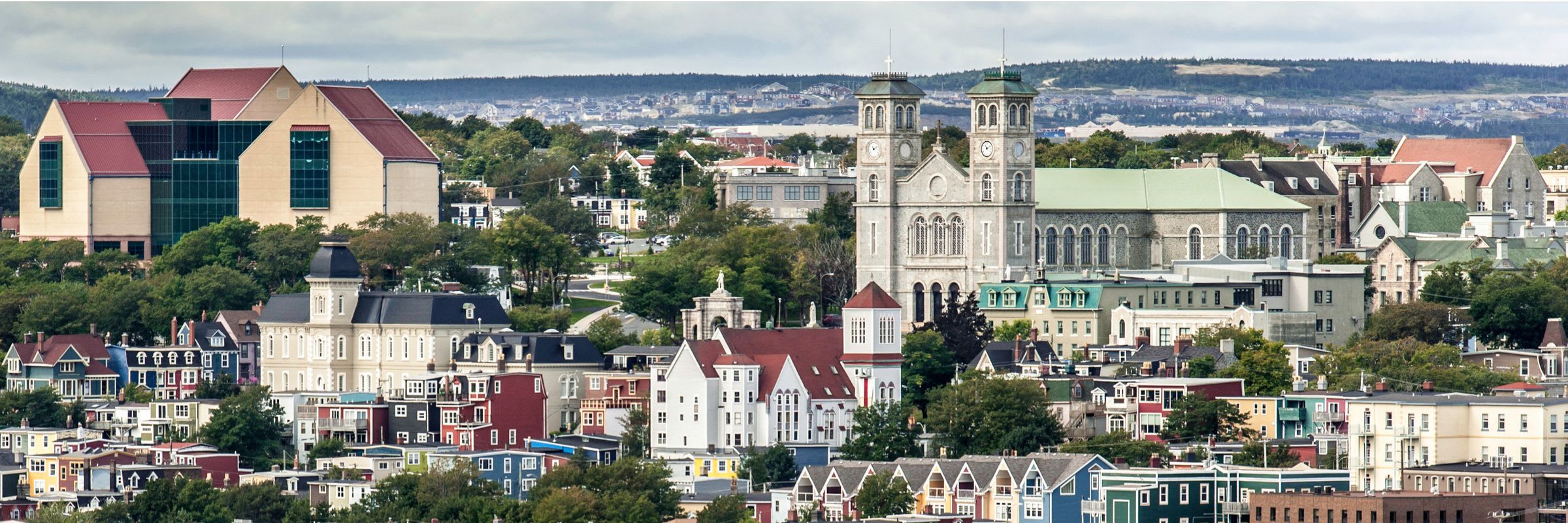
Newfoundland & Labrador Commercial Real Estate Market Overview
Out-of-Province Investors Drive $1-Million+ Multi-Family Deals in Newfoundland & Labrador
According to Burton, 15 transactions over $1 million closed on MLS between January 1 and August 31 of this year, up from nine one year ago, with multi-family accounting for some of the province’s largest deals. A 169-unit apartment building in Gander sold for $25 million following multiple offers to an out-of-province buyer, while a 133-unit property sold for $36.6 million, both underscoring strong investor demand.
Major Rental Developments Planned as CMHC MLI Select Supports Multi-Family Values
Several new multi-family developments are planned or underway, supported in part by CMHC’s MLI Select program. Major projects include 120 LeMarchant Road, a 417-unit 13-storey development valued at approximately $140 million, and Tiffany Towers, a 283-unit project expected to cost more than $120 million. Smaller developments are also planned in Mount Pearl, Gander and Corner Brook, while strong acquisition activity has pushed multi-family values significantly higher over the past year.
Severe Industrial Inventory Shortages Force Tenants into Long-Term Lease Commitments
Outside the multi-family sector, where support is less readily available, developers remain cautious, with memories of past false starts top of mind. New industrial construction is almost non-existent, forcing businesses to reconfigure existing properties rather than develop available land. Demand spans flex, warehouse and yard space, with product on one-acre parcels and offering 30-ft. ceiling heights most coveted. Some tenants are prepared to sign leases of up to 20 years to secure suitable new properties.
High Occupancy in Retail Hubs Contrasts Gradual Downtown St. John’s Office Recovery
Retail remains largely occupied across the province. The Shoppes at Galway, anchored by Costco, is maintaining high occupancy, while vacancy at Avalon Mall, with its mix of 140 regional, national and international retailers, sits at approximately five per cent. Challenges continue for Downtown St. John’s office sector, with vacancy near 28 per cent, although sentiment is improving as sublease space is absorbed and larger availabilities of 10,000 sq. ft. or more become harder to find. Conditions are tightening in select buildings, including Cabot Place.
Energy and Mining Investments Underpin Newfoundland & Labrador Commercial Growth
Supporting the broader market is significant investment in energy, electricity, mining and infrastructure and iron ore development, including major resource and energy projects such as Bay du Nord and Churchill Falls. These projects are expected to contribute to employment and economic activity, although their ultimate impact will depend on implementation, market conditions and other factors. Major resource and infrastructure projects may provide support for future population growth and labour demand; however, demographic outcomes remain subject to a variety of economic and policy factors.
Frequently Asked Questions
Multi-family residential continues to account for some of the province’s largest transaction volumes, attracting significant out-of-province private and institutional capital alongside strong CMHC MLI Select development support.
Key multi-family projects include 120 LeMarchant Road (a 417-unit, $140-million development) and Tiffany Towers (a 283-unit project valued over $120 million), alongside smaller apartment developments planned across Mount Pearl, Gander, and Corner Brook.
New industrial construction is almost non-existent, forcing businesses to reconfigure existing spaces. Occupiers are seeking flex, warehouse, and yard space on one-acre parcels with 30-ft. ceilings, with some tenants willing to sign 20-year leases to secure suitable space.
Retail remains highly occupied across the province. The Shoppes at Galway maintains high tenant occupancy anchored by Costco, while Avalon Mall’s 140 regional, national, and international retailers operate at approximately five per cent vacancy.
Downtown St. John’s office vacancy remains elevated near 28 per cent, but market sentiment is improving as sublease space gets absorbed and prime footprints over 10,000 sq. ft. become harder to find, tightening conditions in select buildings like Cabot Place.
Major resource, mining, electricity, and energy projects—such as Bay du Nord and Churchill Falls—continue to drive employment, infrastructure investment, and broader economic confidence across the province.
About the Report
The REMAX Canada Fall 2026 Commercial Real Estate Report includes data and insights supplied by REMAX brokerages and analyzed by Point Blank Communications. REMAX brokers and agents are surveyed on market activity and local developments. Each REMAX office is independently owned and operated. Responses are meant to capture industry-level information and are not meant to serve as an indication of Real REMAX Group's company-specific growth trends.
About the REMAX Network
As one of the leading global real estate franchisors, REMAX, LLC is a subsidiary of Real REMAX Group (NASDAQ: REAX) with more than 145,000 agents in nearly 8,500 offices and a presence in more than 120 countries and territories. REMAX Canada refers to REMAX Canada, Inc., which is a subsidiary of REMAX, LLC. Nobody in the world sells more real estate than REMAX, as measured by residential transaction sides. REMAX was founded in 1973 by Dave and Gail Liniger, with an innovative, entrepreneurial culture affording its agents and franchisees the flexibility to operate their businesses with great independence. REMAX agents have lived, worked and served in their local communities for decades, raising millions of dollars every year for Children's Miracle Network® and other charities. To learn more about REMAX, to search home listings or find an agent in your community, please visit remax.ca. For the latest news from REMAX Canada, please visit blog.remax.ca.
Forward-Looking Statements
Some of the statements in this press release are "forward-looking statements" within the meaning of the federal securities laws, including Section 27A of the U.S. Securities Act of 1933, as amended, and Section 21E of the U.S. Exchange Act of 1934, as amended, and the U.S. Private Securities Litigation Reform Act of 1995, including statements regarding the stock repurchase authorization. Forward-looking statements include all statements that do not relate solely to historical or current facts, and can generally be identified by the use of words such as "anticipate", "believe", "estimate", "expect", "intend", "plan", "potential", "project", and similar expressions or future or conditional verbs such as "could", "may", "should", "will" and "would". These statements inherently involve numerous risks, uncertainties, and assumptions that could cause actual results to differ materially from those projected in these statements. Where, in any forward-looking statement, Real REMAX Group expresses an expectation or belief as to future results or events, it is based on Real REMAX Group's current plans and expectations, expressed in good faith and believed to have a reasonable basis. However, Real REMAX Group cannot give any assurance that any such expectation or belief as to future results will be achieved or accomplished. Significant risk factors that may cause such a difference include, but are not limited to, slowdowns in real estate markets, economic and industry downturns; the inability to successfully integrate the companies; Real REMAX Group's ability to attract and retain agents and franchisees; Real REMAX Group's inability to successfully launch new products and features; Real REMAX Group's inability to scale while improving operating leverage, or inability to successfully execute its strategies; possible unfavorable results in legal proceedings; changes in laws, regulations or the regulatory environment affecting our business; disruption to our technology or cybersecurity incidents; and other risk factors detailed from time to time in our reports filed with the SEC, as well as in legacy Real's and legacy REMAX's reports filed with the SEC, including legacy Real's annual report on Form 40-F, reports on Form 6-K and other documents filed with the SEC, and legacy REMAX's annual report on Form 10-K, quarterly reports on Form 10-Q, reports on Form 8-K and other documents filed with the SEC, copies of which are available at www.sec.gov, and legacy Real's reports filed with Canadian securities regulators, including legacy Real's audited annual financial statements and annual management's discussion and analysis for the financial year ended December 31, 2025, Annual Information Form dated March 4, 2026 and quarterly financial statements and quarterly management's discussion and analysis for the period ended June 30, 2026, copies of which are available under legacy Real's SEDAR+ profile at www.sedarplus.ca.